The Ghost Water Between
I spend a lot of time fishing the highest reaches of this stream, up around 5,000 feet. Up there, it is exactly the kind of Southern Appalachian brook trout water you dream about: cold, tight, steep and full of pockets. On a good day, nearly every piece of holding water seems to have a native brookie waiting in it.
Today I decided to explore farther down the mountain, somewhere between roughly 2,500 and 3,000 feet. Below this section, the stream eventually reaches Delayed Harvest water that still holds plenty of wild rainbow and brown trout—fish that likely trace back to earlier generations of stocking.
Because this middle stretch was remote, difficult to access and surrounded by beautiful forest, I expected it to fish incredibly well.
Instead, it felt like a ghost town.
I found only brook trout, but there were very few of them. Most were tiny—maybe two or three inches long. Then, almost out of nowhere, one fish changed the entire day: a 10-inch Southern Appalachian brook trout.
In water like this, that is a true trophy.
That one fish made the mystery even more interesting. How could a stretch produce such an exceptional brook trout while seeming nearly empty everywhere else?

What Happened to This Section?
My honest answer is that I cannot know from one fishing trip, but I doubt there is a single explanation. What I saw looked like several limiting factors stacked on top of one another.
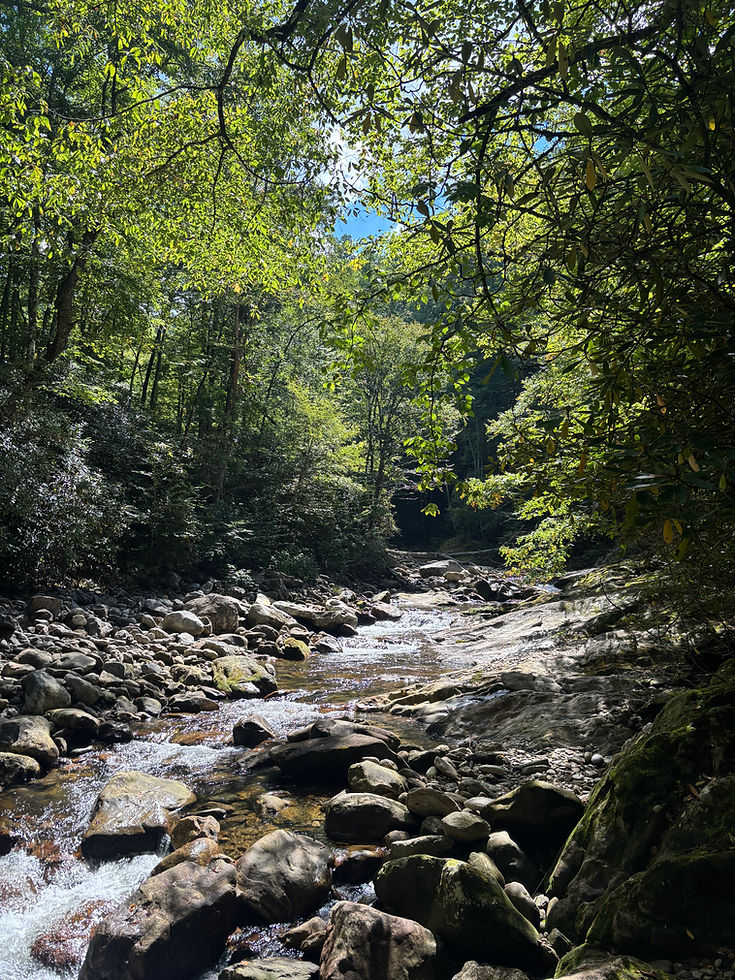
The most obvious difference was the streambed. Much of this reach was exposed bedrock rather than a mixture of gravel, cobble and boulders.
It looked clean and pristine, but clean-looking water is not automatically productive trout habitat.
Brook trout need more than cold water. Gravel provides spawning habitat, while broken rock, undercut banks, woody debris and deep pockets give young and adult fish places to feed, hide and survive high water. Smooth bedrock offers far fewer of those small refuges.
I also wonder how much Hurricane Helene changed this reach. The storm may have scoured away loose gravel, cobble, woody cover and even fish, leaving behind much of the exposed rock I walked across today. A steep mountain stream can move an unbelievable amount of material during a major flood. Trout can survive those events when side channels, deep pockets, boulder fields and other low-velocity refuges remain. But a reach stripped down to bedrock may take much longer to recover.
The shape of the channel may matter just as much. In places, the stream seemed spread wide and shallow. Even pools that appeared deep enough did not seem to hold many fish.
Wider, shallower water generally provides less overhead security, fewer protected lies and more exposure to summer heating. “When I checked the river, it was 63°F—not dangerously warm, but close to the upper edge of ideal brook trout water and warmer than I expected.”
At 2,500 to 3,000 feet, that could make this a marginal transition zone for brook trout—still cold enough for some fish to survive, but not as consistently cold, oxygen-rich and protected as the headwaters above 5,000 feet.
That could help explain why the stream is so different at its two ends.

High above, native brook trout dominate the cold, isolated pocket water. Farther below, the lower gradient and larger habitat support wild rainbows and browns, which often compete more successfully in warmer or altered reaches.
The middle may sit between those two strongholds: too exposed and unstable to carry a dense brook-trout population, yet possibly too steep or separated for the downstream rainbows and browns to establish themselves in numbers.
There is always the possibility that the fish were simply difficult to detect. Low, clear water, bright conditions, recent pressure or fish concentrated in only a few surviving refuges can make a stream appear emptier than it actually is.
But after covering that much water and seeing the same bedrock-heavy habitat repeatedly, I do not think fishing conditions tell the entire story.

One Big Survivor
The 10-inch brook trout may have been an older survivor occupying one of the few truly good lies in the entire reach. It may have moved down from colder water above, or it may simply have benefited from having very little competition for the available food.
Whatever its story, that fish proved the middle section is not dead. But one trophy does not necessarily mean there is a healthy, evenly distributed population.
The best way to understand this water will be to return during different seasons, carry a thermometer and compare temperatures in the high, middle and lower sections. I also want to note where gravel, cobble, woody cover, tributaries and deep flood refuges begin to reappear.
Future visits could reveal whether those two- and three-inch brookies represent a recovering year class—or merely the few young fish currently able to hold on.

Today was a reminder that a wild stream can be beautiful, remote and frustrating all at once. Sometimes the hardest water teaches you more than the water where every pocket produces a fish.
I entered this middle section expecting abundance. Instead, I found questions, a handful of tiny brookies and one remarkable 10-inch Southern Appalachian brook trout holding on in the ghost water between two very different trout fisheries.


Comments